VISIT MY YOUTUBE CHANNEL,.

A companion blog, The Metacognition Project, has been created to focus specifically on metacognition and related consciousness processes. Newest essay on TMP: Goals and Problems, part two

Saturday, April 10, 2010

Responsibility Doesn’t Go Away

It is an axiomatic notion: for a thing to be done, someone (or something) must do it [1]. A simple extension of this notion is that someone is responsible for, in the sense of ‘should perform,’ the action. Try this example: in a family the father has certain responsibilities determined by the social system of expectations and the natural needs of living things. If the father is either absent or otherwise fails to meet the expectations of responsibility, then the responsibilities cannot be simply ignored, but must devolve to some other. The mother may take on all or most of them, or the mother and children adapt to supply the needs through some pattern of sharing. If the responsibilities are not met in some fashion or other, the family fails and ceases to exist as a communion.

In the case of a family in a given society it is relatively easy to produce a ‘handbook’ of responsibilities for the various members [2]. But, the society at large has responsibilities for it to function as well. These responsibilities, while generally clear, are not so easy to assign, especially in the present state of social, economic and political deterioration; once some assignment of first responsibility is made, it becomes even more difficult to follow the devolution of responsibilities to others if responsibilities are not met, or sufficiently met (or ‘met’ in a pathological way), by their original proprietors. As with the example of family, failure to meet these social requirements result necessarily in the destruction of the society.

Here are a number of the responsibilities and their original proprietors as I have analyzed them (it must be remembered that these must be met by someone, even if not met by the original proprietor – it does no good to only complain that they are not met):

1) A reasonably accurate accounting needs to be contained within the general public of the history, processes and rules of the society. There can be disagreements, and should be, but these also need to be subject to recognized process, understanding and documentation. – This is the responsibility of the general public to acquire and maintain, as well as that of the practitioners of education, but first and foremost, the general public.

2) Current events and issues need to be understood in their most basic and undisputed details, and then further considered and debated in light of and by the processes in the first responsibility. – Aspects of this responsibility belong to the public and other aspects to the fourth estate, a free and unfettered press.

3) An economic system must be designed and maintained that supports the essential commerce of the society and that functions to maintain social order, stability and safety. – The representatives of the people, that the people, in their application of #s 1 and 2, have selected to debate and perform in a body of sufficient size and talent that this and other community decisions can be made.

4) A system of commerce must be created and maintained, following the economic designs above, that supports and funds the other responsibilities rather than offending them. – Primarily a business community, but must ultimately be overseen by the general public.

5) Systems of laws must be made and maintained that respond to the changing conditions of life as the society changes both its actual condition and its understandings of the world. – The people’s representatives and a judiciary selected by the people, though ultimately the people are responsible, through the application of #s 1 and 2, for the overseeing of these functions.

6) Threats from without and within must have a counter force in the form of national armed forces and police forces. This responsibility is for the protection and safety of the people. – The military, police and other public safety institutions.

7) The weak and infirm of the society have to be considered in ways that enhance and do not diminish the society. – Some publicly sanctioned and funded welfare system.

8) The society must afford all of its citizens the opportunities for the essential human goals of life, liberty and the pursuit of happiness. All the activities of the society, as it confronts the events and actions of both its own citizens and those of institutions and other nations, must be judged by this responsibility. – The people’s representatives and the general public.

As we look at these responsibilities and those who are first in line to take them on, two observations stand out for me: one is that all the other responsibilities depend on the first two, and secondly, that the general public is failing to meet those two responsibilities. The questions are then: to whom do these unmet responsibilities devolve and how are they being met?

Let it be clear at the outset, the society will fail unless all and more of these responsibilities are met in some way. The form of failure may not be so clear as, say, the walls of our buildings crumbling and people dying in the streets; failure can also come in the form of changes in society’s principles so drastic that ‘we’ are no longer the social order that we intend to be and think we are.

It may be that these concepts seem naïve in this context; it may seem that societies simply do not function nor can we expect them to function with the support of a knowledgeable body politic. This is a reasonable response to the failure of the general public to take responsibility for their own lives; we have ceased to have a knowledgeable public as an expectation. But who is the responsibility for the public’s knowledge of history, mores, laws and current events to devolve to? How and in what form can a society survive if the people in it know little about its form or function?

Our dilemma is doubly schizophrenic. We decide many issues by asking the people to vote in a straight ‘majority rules’ model; and yet the assumption is that the public is deeply ignorant of history, government, law, the content and consequences of what they are voting on and the major issues that impact the nation and their lives. Secondly, we do not trust (and I believe rightfully so) anyone or any institution to take over the full responsibility for the major decisions upon which the public is asked to decide; and yet we have been giving up that responsibility to the absolutely worst possible institutions: business and corporate players.

No matter how bad government gets, at least those that have to stand for elective office must show some performance of the public good. Corporations need only use the brute force of economic power, like the most Draconian of tyrants.

But I am getting ahead of myself. In a properly functioning democracy it is the essential responsibility of the citizen to be adequately educated in the history, functioning and issues of the society. When the people fail to meet that responsibility to whom does that responsibility devolve and with what consequences? The next essay will tackle this complex and thorny question.

[1] Physical and living processes are either inherent in the thing itself, e.g., the properties of an electron, or contained in physical design, e.g., information contained in the structure of DNA translatable into a phenotypic representation; there is not a ‘someone.’ In human action this ‘process in design’ is a powerful force, but is often ignored in favor of seeing the action arising from an individual or individuals acting in communities of interest. I will continue with that conventional understanding for as long as is practical here.

[2] I venture to guess that the ability to realize and state those responsibilities would correlate positively with the success of children in school, the stability of families and other measures of human success.

Sunday, April 4, 2010

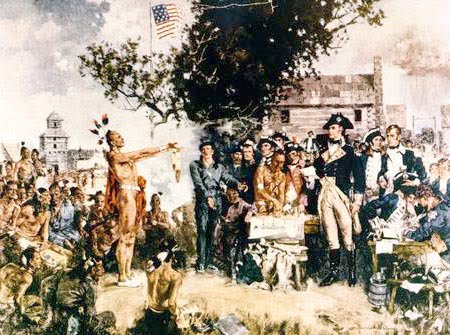
This Time ‘We’ Are The Indians


I have read many essays and papers looking for either that one essay filled with explanation, solution and hope or a constellation of essays and papers capable of compilation into those same virtues.  There are many that nibble at the edges, but not one that is the Salk vaccine for our systemic polio.  I know that there are hundreds of pure geniuses and thousands of really smart motivated people trying to answer the questions of our time, as well as trying to produce prescriptions for present and future actions.

If all this effort could be brought together, it should be possible to design a plan for how to effectively address the major, and even minor, issues of our time.  Unless… unless we, the Great Many, are not what matter, but are more and more in the way of the future, in the way of ‘manifest destiny’ as seen by the plutocrats and oligarchs who increasingly rule this nation and world.  We would be then the “aboriginal Americans” and our issues, our troubles would be being delivered by the corporate invaders.  We seek solutions, but as in the conflict of the Indians and European settlers, what was good for the settlers was definitely not good for the Indians and vice versa.  There was just no way to compromise the clash of ‘realities.’  That is more and more seeming to be the true design of our present difficulties: there is not a compromise position waiting as yet undiscovered, no solution that is eluding us.

Ultimately, the invaders took what they wanted. The Indians were given no satisfactory option; their last big push at solution to their dilemma was the Ghost Dance, a pure fantasy Indian fundamentalism based on the insanity that the invaders could be disappeared if ‘the people’ only acted correctly: the victims having only the power to use their helplessness, and so tried to remake the helplessness into a source of power.  And we have seen what happens when we use our helplessness alone to stand against the press of mad power.

The present situation is, however, not at all the same in all ways. Even if the Great Many are to be the Indians and the people suckling on the Corporate Oligarchy are the Europeans (or the Borg of Star Trek), and it certainly is looking like that is the model, the only way for it to work is for the Great Many to believe that they are helpless.  The Indians didn’t believed themselves helpless, even when ultimately they were.  We often believe ourselves helpless when ultimately we are not!

I have no way of knowing (which is its own issue) whether the symphony of events making up the social presentation of life and “culture” comes from some coordinated plan or is just the economic process run amok, but it is clear that the flood of information into and onto the Great Many is: largely untrue, fear producing, emotionally addictive, power draining, action stopping and, did I say, untrue.  A most flagrant example, clearly tipping the oligarchic hand for those able to listen, was the admonition to “go shopping” after the 9/11/2001 incidents.  The (slightly) more subtle, “this changes everything,” really meant; ‘This makes it possible to be more open about the invasions and evasions of public rights and responsibilities that have been in progress for sometime.’

If we are to be the Indians, then we have to believe ourselves small and helpless, otherwise our great numbers and the fact that it is the Great Many that makes the whole thing go could at any moment overwhelm the corporate oligarchy.  Think about it; what is the message from the media? Is it that each and everyone is powerful? Or is it that you will be crushed by the economy if you don’t have a credit score in the 700s?  Is it that you should organize with like-minded people to live a fully satisfying life? Or is it that there are serial killers on every other street, gangs rule the neighborhoods, be afraid?  Is it to use your resources wisely and live for the human and community pleasures of life? Or is it that ‘success’ is money, possessions and uncommitted sex with a hot bod, regardless of how you get them?  And all attainable only by full admission and commitment to the individualist and materialist religion.

Another message is that the oligarchs are really us, that we have the same interests and that ‘we’ are to aspire to be ‘them.’  And since we have the same interests ‘we’, who are not them, should do what is good for the ‘we’, who are them. This is, of course, madness.  If we are the same, then why are we to aspire to be them.  Why would all of the variety of the Great Many want to live the narrow description of the corporate princelings?

But as I said, our present situation is not a few disorganized, weakly armed, bands of ‘us’ facing the ‘white eyes’ who are like the stars of the sky.’  There are about 300 million of ‘us’ and a few million of ‘them,’ the oligarchs.  We are the stars of the sky.  We also actually control everything.  Rest assured that all but the most disinterested of the oligarchs know that (or rest disturbed!). 

What we are, however, is disorganized: we have the wealth collectively, we have the numbers, we have the real levers of action; we do not have the education, we do not have the organization, we do not have the leadership and we lack many of the intermediate tools of organization, control and coercion.  By this I mean that we don’t control police functions or many economic tools, our main power is the withholding of our support for the present order.  If we do this individually, the effect is insignificant; done in large numbers the effect is devastatingly powerful.

The Indians did not have this option, even though sometimes they tried to use it by refusing to be part of the reservation system, and so were simply allowed, in many cases, to die in foodless winter camps hounded by the army and the settlers; or were hunted down and killed in major and minor massacres.  If the Great Many could decide to hold a general strike, it would not be like a few starving Indians refusing to be driven onto a reservation and easily ignored. 

What would be required for the Great Many to regain control of their lives and destinies? That is what is at stake.  That is what is missing.  We would need what we do not have: knowledge of our real power, organization, leadership, some intermediate forms of power (mainly through organization that could use our collected wealth), a single important focusing common interest and the communication and courage to use our ultimate weapon: the in-mass refusal to give our support to the oligarchy.

The oligarchy has come to believe that the amassing of wealth and the manifestations of power seen in actions of those subordinate to them give them the advantages of the conqueror.  We can see this displayed more and more everyday as it becomes increasingly impossible to hide flagrant assumptions and abuses of power:  the granting of nearly unlimited personhood to corporations, the willful violation of antitrust laws in corporate mergers, the direct writing of legislation by the corporations intended to be regulated by those same laws, the seamless movement of members of the oligarchy between corporations and government, the obvious and unchallenged lying (obvious to those who read and remember) of just about everyone in power, the clear “ownership” of political leaders by corporate interests and on and on we could go [1].

The oligarchs are only in control because the Great Many have been doing as they are told, and believing what they are told.  While I can find no rule in physics or psychology to support it, it seems to me that people will eventually reject identifiable lying even if there is nothing else to take its place. The people of the Soviet Union, in large numbers, came to understand that nothing they were told could be believed. This is both empowering and disempowering: empowering since it is not the lie that is acted on, but disempowering because the information necessary for action is not clear.  As the Russian people became more and more demoralized, the Soviet Union became weaker and weaker – a hollow shell and eventually the international criminal enterprise it is today [2]

This is the direction in which the US is heading.  While some might say that we are already there, I don’t think so quite yet, though we are close.  If the population becomes less educated and less critical in their collective thinking, if laws and rules are passed and enforced that further limit popular organization and expression (the de facto impossibility of third parties, for example), we will be left with only the general refusal to give our work and skills to the corporate state as a means of expression.

There are many people who believe in God and Country, who have been conned into rooting for the home team, people who are being fooled by wedge issue strategies.  Others continue to believe that they are just one lucky move away from becoming a junior associate princeling themselves.  Still others would rather ‘go along to get along,’ ‘watching their Ps and Qs’ and generally clichéing their ‘making no waves’ way of life through life.  As the dishonesty becomes unavoidable, confidence is shattered – like the standing buildings after a big earthquake, there is serious structural damage.

Whether the Great We realizes in time, that we must restore the oligarchs to their true role as our servants, will decide our fate.  There is no question that they will not give up the status of princeling without a fight.  All the complexity really does come down to the Indians (the people) versus the settlers (the oligarchs), but this time the people have all the power if they but realize it.  Had the Indians been able, in the beginning, to organize the many different tribes, the invaders could have been pushed into the sea.  But they were divided by many competing interests.  In most cases the invaders’ numbers were bolstered by members of competing tribes; but having no loyalties, the invaders would then turn on their previous supporters using new helpers bought by some new disingenuous promise.  This proceeded until the invaders had the power to frontally overwhelm all who rose against them.

Piecemeal controls have lost their possibility; the oligarchs too entrenched.  Only a general strike can put the elites in their place and make clear who holds the ultimate power.  And that tool is within our power.  If we are lucky and have the right leaders, such a strike, properly followed up with political action, could reset the clock on the entropy of our democratic system; though it could also speed us along on our way to a criminal state.  But, doing nothing will guarantee a victory for the corporate invaders and our enslavement on the national reservation that was also once our own land.
  
[1] Violation of Constitutional war powers of congress, bribery of public officials by lobbyists, ignoring clearly demonstrated public will in favor of corporate interests, supporting and profiting from the actual extortion and theft of public moneys in the various “bank bailouts,” executive branch threatening of independent agencies (especially in the Bush administration), weakening of usury and bankruptcy laws, removal of consumer and environmental protections, war crimes that violate both our own and international law and again this could go on and on.

[2] A national state-established criminal organization is one that exists for its own maintenance and parasitizes the captive population; there are and have been many such states.

Saturday, March 27, 2010

The Back of My Envelope

The back of my envelope has grown onto the kitchen table, then onto an Excel spreadsheet and then escaped into the desperation of my mind: the only solution (if it can called ‘solution!’) is that the human species reduce its use of the earth’s biological resources by about 80% and its extractive industries by even more.

I don’t want this to be the answer. If people could fly around in jet planes with theirs heads buried in the most recent version of Game Boy, plugged into iPads at their every pore all the while eating Big Macs on gold plates and spaying insecticide into every nock and cranny– and the world’s ecosystems and biophysical cycles be unaffected – I would not care one whit, would be deeply relieved and would go on walks in the woods, ride my bike to the post office and read/write in happy contentment about a hundred other things that fascinate me.

But it is simply not so. Our billions are becoming the locusts in the grain fields. Our industries and tiny travel factories, our patent laws and biogenetic engineering, our simple requirements for food, water and lebensraum all are pitting our presence against the intricate structures of order that support the ecosystems and millions of species presently representing life on earth.

Could the worst possible consequences of human excess ‘end life on earth?’ Certainly not, but economic failure (human economic societies are the most fragile structures of their type on earth), the capturing of every last calorie by humans driven to extremus, the water and food wars and likely use of nuclear, biological and chemical weapons as social and political order collapse would so damage the biosphere that the present rapid extinction rate would be strongly punctuated. Most of the world’s large region-defining animals would quickly die off and probably ½ or more of the total species – along with ecosystem integration – would disappear.

The human experience would be awful: fear, pain, starvation, torture, mutilation would all exist at unprecedented levels. Just imagine a large city or a mega-city region, up to a hundred million people in a concentrated space, when the food trucks stop rolling in, when the water taps go dry. The first such general system failures in industrial world cities are only 20 to 30 years away without changes in our present behavior. ‘Practice’ failures are already happening if we will but see them: the horn of Africa, several regions of India, for example.

I see no directions being changed. Imagine that the system failures begin in changes in agricultural production, weather patterns fail to match the refined expectations of a calculated farming plan, yields are below necessity, packaging and distribution systems are compromised. The cascading economic failures would trigger ecosystem destruction as people began to take their personal survival into their own local hands. If just one mega-city region were to have a serious failure of food delivery and a disruption of other primary infrastructure, water, electricity, waste removal, policing and fire control services, the spread of economic and environmental collapse would be unrecoverable.

We buy home alarm services, some of us own guns, some people keep a few gallons of water and several days of food on hand. All of these things take effort and a belief that our present levels of comfort and safety could be challenged and that it is wise to prepare for such a possibility. There are two ways to look at such preparation. One is that it would be a 2 foot floodwall facing a 100 foot wave; the other, that the sentiment is right, but the level and focus of preparation is misguided. I tend toward the second.

Of course, it is possible that the human species will slip past this coming constriction of possibility without having to think about it, that some miraculous event will ‘change everything.’ But, these things are usually the Devil’s own bargain: a great epidemic disease; some technical fix that just digs us deeper in the hole, but that we grab for; a draconian social/political movement mixed with messianic certainty. This is usually how we do things.

But the stakes are higher this time. The Roman Empire could slowly crash to its knees and become medieval Europe at the same time as its blown embers helped to ignite the Middle East. There were less than ½ a billion people on the earth and ‘a million’ places to go. Most people were close to the land in an agrarian world. Today there are billions of people who have never planted a seed, killed a chicken or picked a berry, taken a drink from a stream, built a fire, slept on the ground, walked 10 miles with weight or any of the other things that are the immediate requirements of remaining alive in a world that doesn’t supply these needs on a complex economic model. And they will not go gentle, etc.

This time around human beings need to use their powers of reason, science and imagination to plan their way. The pettiness of power and wealth will have to give way to the dangers and solutions of the best reality discoverable. Unlike the other animals, humans can create their own goals, goals that must include not only the actions we wish to take, but those inhibitions necessary for us to live in the company of the rest of the living assemblage.

Will we do it? Probably not. Most likely a great crash and burn is our future with a species capable of using the Consciousness Order with full effectiveness coming in a distant iteration. But those who can must try.

Friday, March 26, 2010

Investment as Concept and Action

Part one: Investment is the simple idea that ‘I give you something that you want when you need it and after a time you give back to me the original giving plus a little extra.’ I can do this out of good will toward a friend, neighbor or fellow human being (in my circle of inclusion), in which case the little extra is a gratuity; or I can do this as a means to grow what I possess into more than I had before without actually going to the material world and changing something to give it value: the person to whom the “gifting” is made must, however, go to the material world (or some agent must go) to add value to something real in order to return the original “investment” plus gratuity. In other words, regardless of the details of the terms, the very essence of investment, as it functions in human economics, requires that there be more of the material world consumed and changed to some human need or want than existed before the investment behavior.

Present investment activity is not done just among family, friends and neighbors, but often even among enemies. The ‘little extra’ has become the raison d’etre for the behavior, and the accumulation of the extra from many small sources has become the way that vast wealth is compiled; wealth that must be reinvested to just stay the same much less to grow further (a component of this process is inflation of abstract value so that more and more of it is required, as its amount increases, to trade for the same amount of real material value).

Another concept needs to be carefully evaluated to clarify the meanings of investment; that is ‘zero-sum’ game. It is obvious, in a world of unlimited material from which to draw for adding value, that the investment model could, and would have to, continue to increase the amount of wealth in the world forever; it would be completely true that ‘your growth of wealth would not take away from my chance to grow wealth’ [1].

But the assumption of unlimited material from which to draw is clearly incorrect. Therefore the necessity that investment must create increasing amounts of real material value for it to be more than a Monopoly game means that the appearance of the ability of investment to create wealth in such a way that “one man’s gain is not another man’s loss” is simply wrong. It has never been more than a convenient argument for excess.

So long as the evaluation is limited to the human side of the pie the appearance can be maintained that for, at least, some considerable time that pie can simply grow and grow. Those with 90 % of the pie may double their accumulation at the same time that those with 10 % also double theirs – those with excess may hardly notice except for bragging rights while the lower end are raised up into comfort and safety. Of course, any high school physics student should squirm with discomfort at such an argument: the energy must come from somewhere, the earth has a fixed solar flux and there is no input into the system for any material; the laws of thermodynamics are also economic laws.

If an economic system requires for its existence that real material be extracted and have value added by physical processes for every turn of its wheel, and that economic system exists in a space where all materials and energies are being used by established biophysical and metabolic systems at optimum rates that allow the continuous functioning of those systems, then growth of the economic sector must be denying maintenance of order in the biophysical and metabolic sectors. In other words, the game is still zero-sum with the rest of the living world and the future paying the difference.

Increase in wealth, either of individuals or of societies, is a promise to extract and add value to the earth’s material and energy. Otherwise the wealth is only play money. The taking of material and energy is uncompensated in earth system terms and is therefore being taken from existing living systems or from the earth’s system “investment” in future life.

Part two: Natural economies, that is the lawful exchanges of energies and materials in biophysical systems, contain investment-like behaviors, the essence of which is the deferring of immediate use in such a way that there is subsequent gain. Bears store fat and survive the winter; the utility of a thousand calories in February give them value far exceeding the value of a thousand calories in August. Cattle eat a spinach family plant called ‘winter fat’ about ½ way down leaving a goodly part of the plant to grow again the next fall. This instinctual restraint can be seen as an evolved investment in next years food supply. In point of fact, every species of life on the earth, or ever on the earth, has a multitude of such relationships, making many “investments” in its own sustaining and the sustaining of its ecosystem relationships.

Specialized human “investment” in the broadest sense began as a process of social bonding; an investment was made in the community by the sharing of material wealth. Systems of obligation strengthened the community both figuratively and literally: the dividends paid on shared food or shared effort were essential for safety and comfort. It is a perversion to remove the concept of investment and the behavior from that context. The outcome is the run-away positive feedback of our present economics; its only result will be to destroy the substrate upon which it subsists.

The absolutely central design element of our economics is fatally flawed – not in the trivial sense, but in the most profound sense beyond the imaginable: That accumulated wealth must be used to create more wealth, that growth of the power to influence both social and biological designs for the production of wealth is the ultimate goal of existence, that every possible advantage must be discovered and made into a product from which wealth is gathered and, ultimately, that wealth is the goal of individuals and societies. I invite you to read the introductory remarks from any economics text or explanation of the purpose of economics; these are the assumptions so deep as to be beyond question.

Our present understanding cannot begin to comprehend an economics that doesn’t depend on investment in the impersonal and contractual sense of growth of principle. There is no other way to obtain great excess or to maintain excess once it is accumulated. The ‘magic of compound interest’ has poisoned our conception of the reality of living in the actual physical world. What can be more insane than giving a few abstract magic tokens that can be traded for anything to a wizard who after some years gives you back ten times, twenty times, the number that you gave him? Of course, if you study it, you will find that the actual value of your tokens has diminished so that the large number that you have now are worth perhaps only a bit more than the much smaller number that you gave in the beginning, but had you not given the tokens to the wizard, they would not have increased in number at all.

And so the trap is sprung and we all end up working for the wizard. What we have seen in actual fact in the US over the last 30 years is that the great middle is paying back the marginal gains of the 50’s and 60’s. It will not be long before, averaged over the second half of the last century to the present, all of the gains of growth and wealth will have distributed into the growth of population and the accumulations at the top of the economic hierarchy. The middle will still be the middle, but with many more trinkets “required” and more miles to drive to work. An added bonus is the destruction of almost all marginal peoples and the biosphere.

Part three: What can replace growth economics and investment as the organizing principles for human societies? First and foremost, the concept and actuality of sufficiency. A community of humans knows what is sufficient and what is excess. Economics theory is wrong; people do not strive to excess, wants are not unlimited. As I look around the “communities” (really housing developments with some elements of community thrown in) that I live in and near, it is plainly evident that most of these people are not driven to excess. They gather and laugh and eat and play – too often with techy toys, but these are excuses and ultimately incidental.

Most people have accepted that ‘they should seek excess,’ but they are usually too busy with living activities to take it seriously. They must be prodded without mercy: a thousand commercials a day using the most coercive tools discoverable by motivational professionals. There is no place in the human space to avoid an invitation, an appeal, a demand to buy or to save yourself from the troubles created by having bought; because, even without seeking excess, people have been fooled into living beyond comfortable sufficiency.

Another element of sufficiency is the means by which needs are met. Sufficient skills and effort can be “traded” for sufficiency of money and the whole growth economy underlying it. What can you, and what are you willing to, learn to supply for yourself: food, water, energy, entertainment, shelter, clothing, tools of travel, medical care, communication, tools, personal supplies? What would it do to your sense of safety and comfort if you could meaningfully supply some significant parts of many of these; especially, some of the primary needs?

Of course, this is only one small and ‘insufficient’ step. It is the growth/investment model delivering the electricity that forms the words on the screen, powers the printer, reheats your tea. It is that model that creates the walls of the house with their photos and other displays of our good taste and interests. I cannot imagine another behavioral model that would deliver the world that we presently have.

Only we must imagine another model or this one tamed and made to function again within a subservient position to the natural economy. I believe that, seen in the right perspective, the required changes would reform human life in positive, species affirming ways. There are lots and lots of people who strongly disagree with me.

[1] Even in the best of conditions, theoretically non-zero-sum situations still contain zero-sum elements because time and space are not unlimited. This is fully recognized by even those who claim that wealth is not subject to zero-sum restrictions. Ultimately the argument that zero-sum limits do not exist in a given situation is really a sophistry to justify excess. In a true non-zero-sum environment all players with equal effort and skill would succeed and extend success at reasonably the same level; further more, non-zero-sum like conditions would not move cyclically reducing the numbers of those who are the “winners” in the game du jour. No matter how much a capitalist might laud the non-zero-sum-ness of wealth creation, it is still zero-sum pressures that are claimed to drive market behavior in the first place.

Sunday, March 21, 2010

A New Commandment Further Considered

In the recent essay, A New Commandment, I made the assumption that individuals are naturally part of communities and that they have relationships of obligation and responsibility within those communities. I further asserted that failing to recognize and make those relationships effective is a form of insanity. I realize that these views and values are not universally held.

The vast majority of humans retain and experience some significant parts of the human species’ designs of behaviors and emotions. But there are a few millions of us who are sociopathic/psychopathic (forms of madness), very bright and personally driven to attain control over the forces that surround them [1]. These people have taken over our world – not just the human world, but have come to a place where human action, led by them, can significantly change the only biophysical space within which life can occur.

Biologically humans have not been evolving (a term I restrict to mean ‘biological evolution’) in the normal understanding of evolution. Our gene pool has been changing by virtue of its incredible increase in size, vast recombination, distorted opportunity for genetic drift and the lack of genetic exclusion of “failed” phenotypes; but, there has been no natural or consistent ‘unnatural’ selective pressure other than our tendency to episodically kill off significant numbers of our biologically best young men [2].

But we have been adapting to huge changes in our technological manifestations and the consequent huge increases in population, distribution, power and environmental impact. The Living Order processes of information selection, storage and implementation based in DNA are not the source of our adaptive process; the new Consciousness Order processes are. ‘Everyone’ knows this, just not what it means.

The physical order is bounded by the possibilities, the properties, of the matter and energies in immediate relation. Put oxygen and hydrogen together in very low energy environments and they remain separate oxygen and hydrogen atoms, increase the energy to an exactly discoverable point and they combine to form water, increase the energy still more and they separate again into ions.

The living order is bounded, not solely by the possibilities of the matter and energy in immediate relation, but by the information contained on DNA molecules; information that allows molecular systems to modify energies, ‘wait’ for materials and hold together combinations of things that will not combine in significant amounts otherwise.

And yet neither system of order can include in their designs events or processes that do not or have not occurred. The consciousness order is not bounded by such ‘reality’ in its functioning. There are no bunnies with strawberries for eyes – each tiny seed a lens like the eye of a fly; where could this imagining lead? Humans do not have wings, but can imagine making wings and attaching them to arms; where could this imaging lead? The consciousness system of order is bounded by experience and the capacity to combine experiences; it began being bounded by these limits within individuals and small communities and is now “bounded” by these limits as they function in vast, instantly communicating societies. This is both a prescription for nearly infinite “new things” and also a prescription for madness.

For all our denial of it, even we are bounded by biophysical reality. We can imagine that we are not, but ultimately the products of our imagining are limited by what is finally possible. The clinically mad cling to imaginings that only they can manifest within the closed system of their own minds. Societies are mad when they cling to imaginings that can only manifest within the closed systems of their rules, laws and economic orders. Such madness will eventually be measured by The Real and tossed aside.

Except for the terrible consequences, these are easy ideas to agree with; what is difficult is to use our powers of imagining to find our way out of the dilemmas we have created: find our way out, or find our way back – actually both. We must find our way “forward” by first recognizing what we must get back to.

Which brings me round again to the beginning: obligations within a community. The greatest punishment in our prehistory and much of our history was banishment – killing an offender was quick and utilitarian, banishment was an action of ultimate rejection [3]. It was for failure to support the values of the community. If a person could not be trusted to feel and fulfill their obligations to the whole, then they were too dangerous to live within the protection of the whole. This is a value to which we must return. We must use our prodigious powers of imagination to figure out how; it will not be by returning to live in Neolithic subsistence communities of little more than a couple of hundred people, at least, cannot realistically be our first choice.

There are other values (commandments) that we must reinstitute: the absolute compensation for all takings of materials and energies beyond our due from the solar flux. Every organism other than Homo sapiens lives as near to a “revenue neutral” existence as possible; that is, the species takes what it needs and returns supporting products and behaviors to its ecosystem in equivalent proportion often times with the most extraordinary trades. It is as obvious as frog feathers that failure to do so would rapidly unbalance ecosystems resulting in their going through rapid cycles of growth and collapse rather than the magnificent stabilities for which their unperturbed states are renowned [4]. It must be noted that this was also a community value in the deep past (and still is among materially simple peoples). Again we must find new ways of incorporating this value into the future that we make for ourselves.

Doing these things was far easier in the past when humans lived (like every other species in the history of life on earth) in immediate communion with ecological realities. We have the capacity to recognize and respond to those realities without being at the mercy of them, the dependencies and limitations that humans have long worked to overcome; but we must still live within those limits that we dare not exceed. This is the clear lesson of our present situation if we will see it.

The new commandment from the previous essay was, “Thou shalt not eat whilst thy neighbor starves.” As a practical matter, of course, our world is too filled with people for so simple a form of this rule; there is always someone starving. Thousands starve to death every day. If our familiar social, political and economic orders – improved versions of them – are to survive, we must actually care.

We need to adapt and adopt the two values above: If a person cannot be trusted to feel and fulfill their obligations to the whole, then they were too dangerous to live within the protection of the whole, and there must be an appropriate compensation to the relevant ecosystems for all takings of materials and energies. These two “commandments” are really the same, one writ for the human community and other for the ecosystem community. And both essential for our continuation in the biophysical space.

[1] There are strong sexual selection pressures operating at any one time, often driven by media (from the Cro-Magnon sculptures to modern advertising using sexual content), but beyond the basic and seemingly timeless proportions of beauty and desirability, they probably change too quickly to be a selective force with direction.

[2] The continuum of complete control v. abject acceptance has in its middle an adaptive and sane region. The extremes are responses to attempts to adapt to situations beyond the range of normal human capacity; they are responses that lack the balancing feedback of reality. ‘Control need’ sees everything as the pressure points of action for manipulation and misses integration and functional relationship. ‘Acceptance’ sees helplessness confronted by overwhelming power and complication. Both are useful adaptations within a stabilizing community, but are quite mad when isolated into groupings of the like-minded.

[3] Banishment has lost its power in a world of weak attachments and self-banishment. The user and abuser can move to a new place and then move again when discovered. Whole classes of behaviors that were rejected as destructive become acceptable, even desirable, as communities disintegrate and are replaced by the very relationships of abuse that they once rejected.

[4] It is not only logically obvious, but empirically established in energy studies of ecosystems.

Saturday, March 20, 2010

Delivery of Medical Services in the US to Remain a Travesty

The design of our medical services delivery system is devoted to unprotecting the wealth of those who need or will need health services. Since this is everyone, medical services delivery is the perfect place to make money, especially using the market insurance model.

Compare a simple and logical medical delivery system with the one we have now (really not changed by what is proposed in the present legislation). The pricing of medical services is a slightly separate issue to be considered later; for this argument, they are accepted as they are. All people would be taxed at a rate estimated by competent actuaries to maintain a fund from which services are paid and would be evaluated on a fixed schedule. The fund would be administered by either the federal government or the states (or using partnership agreements). Service provider groups negotiate compensation. All medical records are computerized. Services are invoiced by private providers to the single-payer fund. A fraud unit made up of doctors, lawyers and law enforcement would investigate suspicious medical claims by patients. A separate provider fraud unit would investigate suspicious claims by providers. Oversight committees would be established in state and federal government. Physicians, in consultation with their patients, would make decisions for treatment that would, only in exceptional circumstances, be subject to question based on empirically created algorithms.

In this model the numbers of doctors, nurses and other support would be determined by the rate of use of the system, i.e., the number of people that could be effectively seen and properly treated per day. This would necessarily result in changes in the rates of compensation for these service providers, but these amounts would be negotiated by all the stakeholders. Since a major component of this delivery model is the removal of the profit motive from medical services delivery – the designed-in goal would be to gain the greatest coverage for the least money collected from the tax payer – control systems for pricing and populating service components would be designed to use the best available information technology to replace market pricing and resource assigning methods. This would be, in fact, a primary purpose of such a design, since it has been these market processes that have led present medical delivery to be inefficient, inequitable and a major damaging influence on the democratic, social and economic enterprise.

Compare the above sketch of a plan with the present “system:” an individual gets a job; if the employer offers a “healthcare plan,” the employee can pay for it, often as much as ¼ of a typical income (the employee is paying the full cost of the plan; employer contributions are only tax gaming devices). The other option for the employee is an individual purchase of insurance coverage at near twice the amount of group plans. The insurance coverage is filled with rules, deductibles, co-pays, requirements of approvals, processes for denial of service. These rules can change without notice. The price can be changed without effective appeal. The consequence is that millions of people are denied the services that they pay for and millions more deny themselves services that they pay for because they cannot afford the deductibles and co-pays and can’t effectively fight the, often automatic, denials of payment by insurers.

If the individual’s job doesn’t offer a “health plan,” then the employee must buy individual insurance or go without. This means that he or she must pay for medical services on a fee for service basis, if they can find a provider who will see them. Then, in a perversion of market driven systems, they will have to pay more than an insured person for the same medical service; even though the provider has to do less paperwork, a major cost in the system.

Another option for this person is to apply for state-run Medicaid. If the person meets the income limitations this will let them into the medical service system. Providers may refuse to see Medicaid patients, however.

In both models for medical service delivery it is assumed that individuals cannot afford to pay, out of pocket, for possible and even likely medical services, especially for serious acute conditions or long-term illness. For this reason an insurance model is used. In the first model the insurance risk-pool is universal and administered by agencies designed to be neutral to medical procedures and evaluated on the competing goals of health quality and frugality (one can argue with the implementing of these goals, and should, in order to improve their functioning).

In the second model the insurance risk-pool is haphazard and uncertain resulting in a motive to remove people from it who are using services at costs approaching the premium payments. There are motives to make the coverage difficult to use by increasing co-pays, limits and deductibles and other rules. There are motives to select who will be covered or to remove people after they have paid into the pool, but who then will begin later on to use that coverage. There are large costs associated with the bureaucracy of claim denial and all of the machinations of paperwork, etc., that must be paid for by premiums. There are investors to be paid and high salaries for administrators sufficiently sociopathic to manage a money making system on the denial of medical services for other human beings (this is a nasty feedback design – a non-crazy person would not do the job and the people who will do the job will use it to get as much out of the system as they can). There are skyscrapers to be built; jet planes to buy; all the opulence required by the pissing-contest of corporate princedom; all from premiums paid by individuals to “insure” that they will receive medical services.

The Real Rant: The “healthcare bill” presently in congress doesn’t deal with the underlying issue in the difference between these two models. Everything in the description of the second model remains essentially the same except that the risk-pool becomes less haphazard and uncertain. If anything the situation gets worse since the monies available for Medicaid and Medicare are being reduced at both the state and federal level. The increase in the delivery of medical services will be minimal at best, the costs will continue to increase, though possibly (only possibly) at a slower rate. And the big issue: the market model will continue to control medical service delivery with all the negative consequences for the rest of our society. The promise that ‘if you like what you have, you can keep it’ is matched by the unspoken promise that ‘if you don’t like what you have, you can keep that too.’ This country will continue to spend twice as much as the other industrial countries for second best results and the corporate pissing-contest will go on at the cost of all the other services that could be funded by the wasted 1.1 trillion dollars a year (1/2 of the total medical expenditures per year) and the lost and injured lives.

There is only one reason to hope for this bill to be voted in. The mad men who have fought to maintain the present system, and won, shouldn’t get the further victory of being able to crow about their successful destruction of the effort. This is a weak gruel indeed.

Wednesday, March 10, 2010

What We Must Do, Part Two

Essays on these matters commonly speak of “our actions” and “we experience”, as I often do here, but this represents an expectation and an understanding requiring definite structures of power, information flow, common understanding and common purpose.

‘We’ forms in various ways, but always on the basis of some common experience and purpose. The authorities and inmates of a prison become ‘we’ only under the most horrific of circumstances, as when about to be struck by a large meteor – not even an earthquake or an all-consuming fire can turn a prison, uniformly, into ‘we’ – and even then not everyone would join the common cause.

This is a major dilemma: ecological and economic catastrophes, almost certain to occur without large and rapid changes in human action, have to actually happen before there can be a natural constituency of experience sufficient to prevent them.

Humans have been very good at responding to impending threats when a natural constituency of ‘we’ already exists and not so good when the disparate ‘we’s’ have not yet formed into some common collective of experience [1].

The purpose of this little digression is to prepare for this statement: I don’t think that we can count on a ‘we’ forming on these major ecological and economic concerns. And, in the absence of a powerful constituency of ‘we’, there can be no meaningful (globally effective) response until the nearest edge of catastrophe passes unambiguously through our lives. That parts of Africa and Southeast Asia are being buffeted by the coming storm is not enough warning; no, the timing will have to be just right: calamity without devastation might be all that can be realistically hoped for. This is, of course, no reason not to keep trying to inform and build an enlightened constituency; it simply clarifies the difficulty.

Failing popular movements leading the way to reduced consumption and all the other adjustments needed, the obvious option is some authoritarian control operating with persuasion and force. Of course, right now power resides in the forces that are driving the biosphere toward ecological and economic collapse.

Given the timelines that are reasonably speculated – 10 to 30 years within which to produce meaningful change, beginning right now would be very good – it is unlikely that global corporate enthusiasm will shift from hell-bent accumulation to ecological sensitivity quickly enough. But this is not to say that some authoritarian force will not form, from governments or other coalitions, around ideas broadly enough and well enough presented. It is doubtful, should it happen this way, that it will be pretty.

So from this base let us look back (to the previous essay) at the list of changes that the biophysical space requires in order to regain sufficient health to continue sustaining present ecologies, and what we can reasonably expect. The fact is that we cannot expect any sort of general response to any one of these needs. The history is that while individual humans make individual efforts at integration into their environments, the whole collective enterprise bulldozes on growing bigger and more disrupting.

But, we can, each of us, do all of these things in our own lives, and we can inform others. There is no other way to prepare for using calamity, for mitigating devastation. It is not that I consider humanity so very important in the ultimate scheme of things – though the Consciousness System of Order is an incredible addition to the universe – but we hold the present assemblage of life on this planet in our technological hands: if we fail big-time, the rest of the present arrangement of life on earth will go down with us as a sixth great extinction event [2]. In this way I am a consummate conservative; the way life sustains and adapts is by fighting with its fullest force to stay the same.

The first rule has to be, do what is necessary yourself. The second, inform and educate those around you. The third, demand of collective entities that they behave responsibly. Unless you are actively reducing your ecological footprint, learning about the chemistry of pollution, discovering effective solutions to your own consumption and making an active effort to model a way of life that respects and allows all life a place on this planet, then you have no moral authority, on the one hand, and you will not offer a source of expertise when it is needed, on the other.

Read through the list; it is not long. This is what ‘we’ must do to return the earth’s surface to sufficient health to avoid a major disruption of biophysical process. If there is no ‘we’, then one must be created. The changes in our lives and in the social and economic order will, of necessity, be huge; we have been so destructive for so long. Reintegration into biophysical reality will be one more monumental change (adaptation) in the human history of monumental and painful changes.

***

[1] Conservative experience, by its very nature, tends to have more common elements than liberal experience and thus is easier to form together into collectives of common experience and expectation.

[2] The number depends on how you count them; 540 mya, 450 mya, 250 mya, 200 mya, 65 mya. It could be the seventh or the eighth (ninth or tenth) if we knew more about preCambrian times. There was certainly a major extinction event about 700 million years ago when the earth was completely ice covered from equator to poles, and others as oxygen reached toxic levels in an early anaerobic world.

Part three of this essay can be found at Dissident Voice.